Research
My research question is: can design interventions in the media environment reduce perceived polarization?
The mechanism
Perceived polarization is the systematic misperception of political opinion distributions: people overestimate how extreme the out-group is — and misread what their own group actually believes.
It is not a fixed feature of minds. It is assembled by how systems rank, present, and label information — which is what makes it a design problem rather than only a psychological one.
The target is perception, not the factual accuracy of content.
The method
I follow a mechanism-to-design translation approach: from the literature, I identify the mechanism driving perceived polarization, then derive a system-level intervention targeting that mechanism — whether through algorithmic ranking, information presentation, or the surfacing of identity data.
How does the misperception arise?
What informational condition should change? Defined independently of any platform.
How is that function instantiated in the affordances of a particular medium?
Does it causally recalibrate perception?
Separating step 2 from step 3 is what makes it possible to ask whether a principle generalizes across interaction forms — not merely across interfaces.
Three pathways
Three mechanisms, each carried through the same translation and pre-specifying the mediator the intervention is designed to shift.
People substitute a few highly visible extreme members for the out-group’s actual distribution.
Counter-stereotypical exemplars · algorithmic ranking
Perceived group variability · Voelkel et al., 2023
implemented in Lichtung
High visibility is misread as high prevalence.
Distribution overlay · information presentation
Accuracy motivation · Pennycook & Rand, 2021
implemented in Lichtung
The interface compresses multidimensional identity into a single political label.
Non-political identity surfacing · identity-data surfacing
Common ingroup identity · Levendusky, 2018
implemented in Lichtung
What comes next
proposedHow do you measure misperception of opinion distributions in realistic use?
Behavioral telemetry linked to survey measures, so that evaluating an intervention does not rest on self-report alone.
Do these interventions recalibrate perception?
Randomized controlled experiments on the simulator: causal effect, mediation path, interaction between pathways, and boundary conditions.
Do the same intervention functions survive a different interaction architecture?
Not the same interface tested elsewhere — returning to the underlying intervention function and re-instantiating it in the affordances of conversational AI. Which principles hold at the mechanism layer, and which turn out to be artifacts of one implementation?
How I got here
What role does a party-press account play in patriotic propaganda?
The Role of the People's Daily WeChat Account in Political Propaganda — With a Focus on Patriotic Propaganda. M.A. thesis (in Japanese).
Composite-week sampling drew 352 posts from the 9,324 the account published between November 2019 and May 2021. Just under half — 167 — carried patriotic propaganda, and a frame analysis of those yielded three, among them an adversarial-nation frame.
The thesis treated as noise what turned out to be the subject. Its window overlapped the COVID outbreak, and I read that overlap as contamination — the pandemic skewing a study meant to characterize the account in general — so I left that material unanalyzed and filed it as future work. That was backwards. A crisis is not interference in how a national community gets built; it is the condition that makes the building visible.
Two design choices had to change with the reframing. Weeks sampled across eighteen months can show which frames exist but not how they move as an event unfolds; and coding adversarial nation as a single frame folds together two things that need not travel together — positioning the self well, and casting the other as hostile. Whether they in fact travel together became the question.
Constructing the National Community in Times of Crisis: Direction, External Relations, and Internal Representation in People's Daily WeChat Patriotic Propaganda during the COVID-19 Outbreak. Manuscript in preparation, 2026.
I worked from a census rather than a sample, all 2,318 posts the People's Daily WeChat account published between January and April 2020, of which 761 were patriotic propaganda. I coded each on two axes, which direction a post faced and what it did to build "us."
Attention stayed inward in every period, never below 69.9% and reaching 94.1% under national mobilization. That further contraction came from the agenda rather than the framing. Outward topics fell from 15.9% of posts to 3.0%, and the few that remained were framed patriotically at a higher rate, not a lower one. Positive self-positioning and adversarial framing almost never appeared in the same post. The two did not travel together, and facing outward did not mean treating the outside as an enemy. Inside that inward attention, hero figures ran on three recurring title formulas, and the occupations they represented narrowed from a third healthcare workers to nearly nine in ten.
Even Li Wenliang's death fit the template. The hospital confirmed it at 3:48 a.m. on February 7, and ten minutes later, in a window where the account had posted nine times in four months, it published "Farewell, Dr. Li Wenliang," recasting a doctor reprimanded for warning about the outbreak as a medical worker lost to it.
What I took from this was about conditions, not audiences, which the study never measured. A system decides who is visible, and in doing so sets the conditions under which people judge who counts as "us" and who counts as "them." The later work pulls the same lever in the other direction, letting people see what the other side holds instead of deciding it for them.
Would showing people more diverse political perspectives reduce polarization?
A news aggregator that placed coverage of the same event from outlets of differing stances side by side. I retired it after a literature review: the filter-bubble account is weakly evidenced (Bruns, 2019; Arguedas et al., 2022), and cross-cutting exposure can backfire (Bail et al., 2018). The premise was wrong.
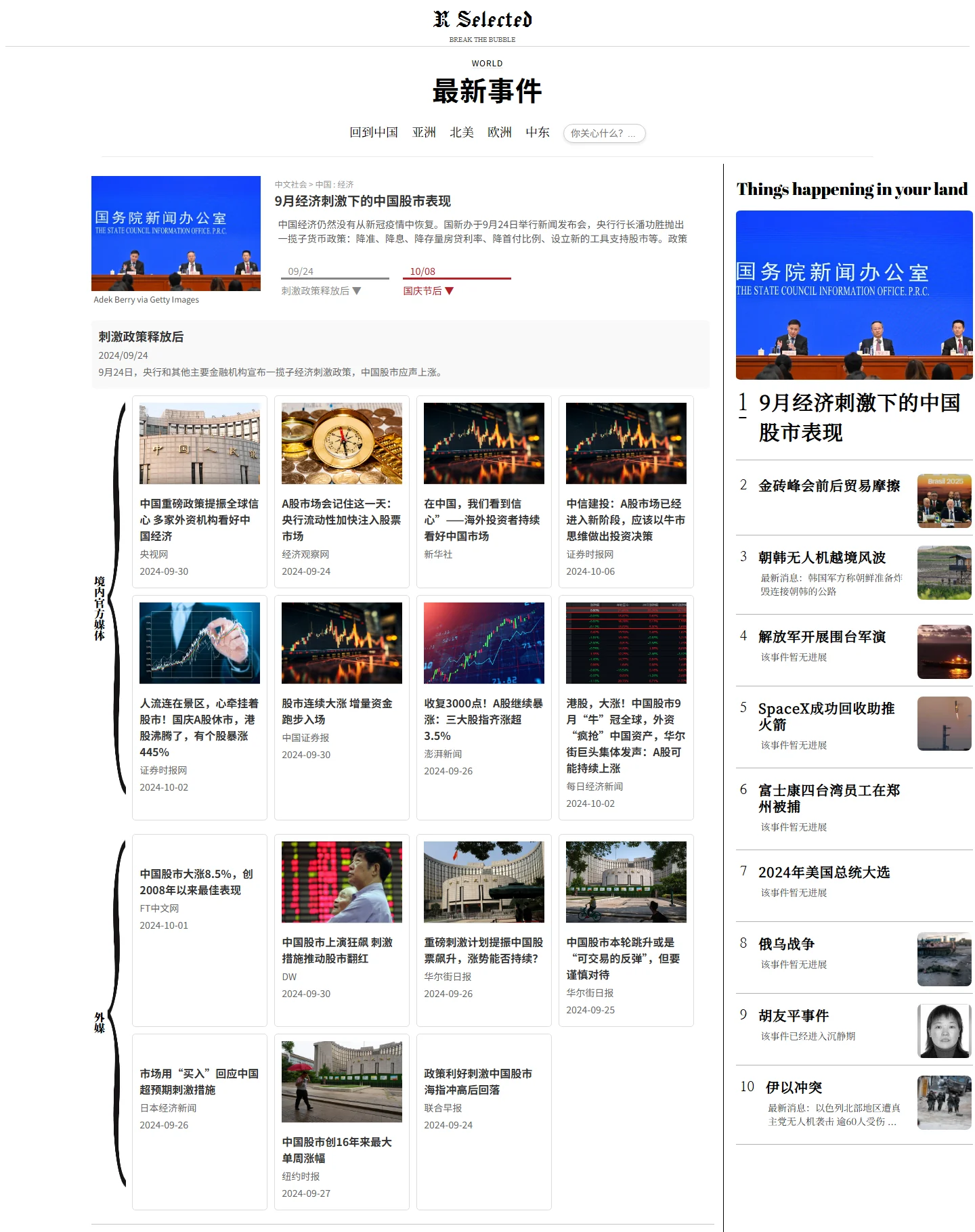
One phase of one event, expanded: the same story as carried by 境内官方媒体 (domestic state media) and by 外媒 (foreign media), bracketed side by side. The tagline in the masthead — Break the Bubble — is the premise the literature made me abandon. The service is retired; this is its original build and database, run locally. Archived copy ↗
What if the problem is not what people see, but how they infer what others believe from what they see?
The target moved from exposure to inference — and with it, the intervention moved from the supply of content to the cues people read it through.